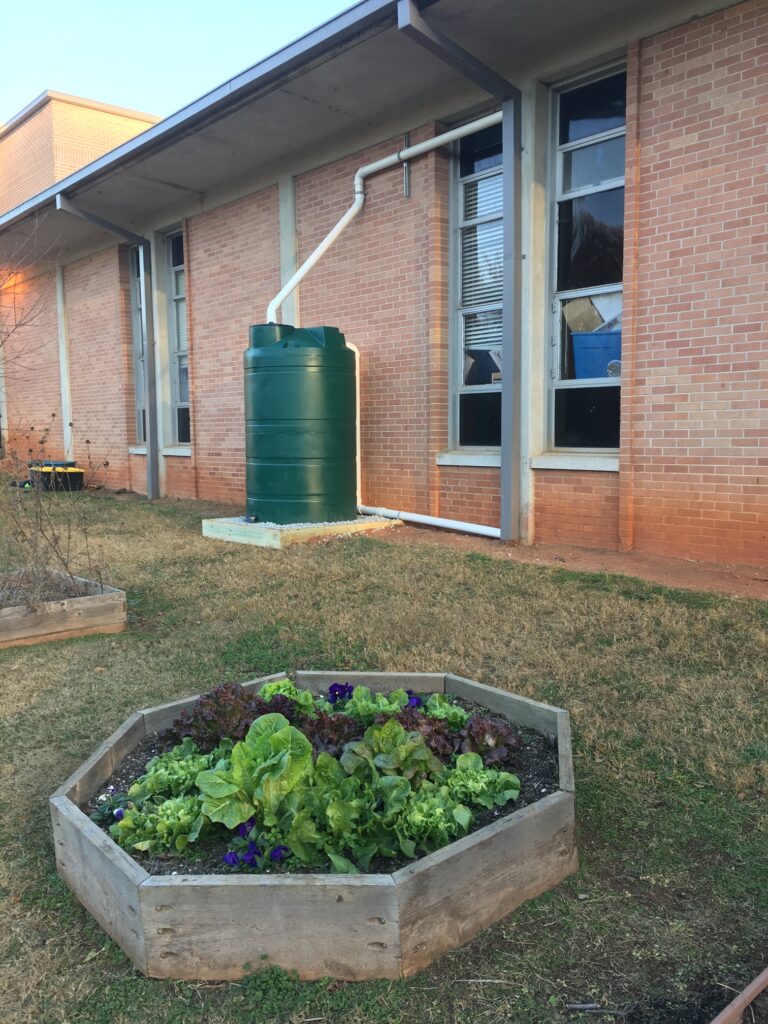
Usually caused by undersized storage, or not enough catchment area. We recommend 1 s.f. of collection surface for each s.f. of garden, with 1 gallon of storage in between. The 1:1:1 ratio.
Tanks empty fast in dry spells; gardens still need municipal water as a backup. If that’s not possible, consider doubling the storage.
2) Overflow, erosion, or flooding near the tank
Water dumps next to foundations/beds, washes mulch, creates mud ruts
Usually caused by poor overflow routing, clogged outlets, or undersized overflow plumbing.
Slow filling, water bypassing the barrel, pump starving, drip emitters clogging
Most often leaf litter + roof grit + Georgia pollen; screens just need a simple cleaning routine.
Add a self-cleaning prefilter, such as the Leafeater Advanced, available on Amazon or georgiawatertanks.com
4) Mosquito complaints (the #1 “neighbor issue”)
Happens when lids/vents/overflows aren’t screened, or water sits in first-flush chambers and piping
The Georgia Department of Public Health specifically calls out standing water in containers like rain barrels as a breeding risk; prevention focuses on eliminating or protecting standing water.
Most industry insiders do not recommend first flush devices anymore. Instead, use a self-cleaning prefilter, and either a screened overflow elbow or popup emitter.
5) Algae, slime, and funky odor
Green water, slippery biofilm, musty smell, stained hoses/emitters
Usually from sunlight hitting the stored water + warm temps + organic debris (tiny amounts add up).
Solution: 100% screened prefilter. Block 100% of light.
6) Community garden–specific: user error & durability issues
Valves left open, hoses disappear, fittings broken, contamination from “helpful” additions
Shared systems benefit from simple instructions, protected components, and fewer ways to misuse (think: lockable spigots and labeled valves).
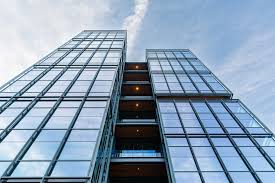
At 1020 Spring Street (Ten Twenty Spring) in Midtown Atlanta, the rainwater harvesting system was designed with one clear mission: provide cooling tower makeup water—exclusively.
That focus matters, because cooling towers represent one of the most consistent, high-volume non-potable water demands in a commercial high-rise. And once a building reaches roughly 7 stories or taller, cooling tower makeup demand is often strong enough that the system can use essentially all the rainwater that hits the rooftop (depending on rainfall patterns, operating hours, and tower load).
This is exactly the kind of application where rainwater harvesting shines: steady demand, predictable control strategy, and real measurable offset of potable water use.
A Modern Midtown Tower with Real Water Demand
Ten Twenty Spring is part of the Spring Quarter district and is positioned as a high-performance, hospitality-forward office destination. The tower is 25 stories and roughly 525,000 SF of Class-A office, with ~32,000 SF floor plates and major tenant amenities and terraces.
In other words: it’s a large building, with large mechanical loads—exactly the environment where rooftop rainwater capture can become a meaningful utility strategy instead of a token sustainability feature.
Atlanta Requires Stormwater Management—& Rainwater Harvesting Can Help Meet It
In Atlanta, post-development stormwater management is required for new development and redevelopment. The City’s Post-Development Stormwater Management Ordinance requires projects to manage the first inch (1.0”) of rainfall using green infrastructure. That’s the minimum; we recommend about 1 gallon per s.f. of impervious.
This is where rainwater harvesting earns double credit: a properly designed capture-and-reuse system can function as a stormwater management device by reducing runoff volume through capture, filtration, and reuse. The City explicitly includes cisterns as a green infrastructure approach intended to capture stormwater for reuse.
And the City’s ordinance update Q&A materials get even more specific: rainwater harvesting and reuse systems must be designed around the demand they serve and include a plan to draw down stored water so capacity is available for the next storm—exactly why cooling tower makeup is such a strong match. Even during an Atlanta winter, a large 25 story building like this will need air conditioning in places.
The Payoff: Potable Water Savings that Actually Matter
Because cooling towers can consume water day after day, this approach can save hundreds of thousands of gallons of potable water over time—often more—by substituting harvested rainwater for municipal supply.
That’s good for the building owner (utility savings and resilience), and it’s good for the broader community by supporting Atlanta’s water conservation goals and reducing stress on infrastructure.
The System Philosophy: Do the Job Well, Without Extra Complexity
This system was designed in-house and installed by McKenney’s Inc., creating a streamlined design-build workflow from engineering through commissioning. For 1020 Spring, the equipment stack is intentionally clean and operator-friendly:
Concrete cistern for storage
Single pump for delivery to the cooling tower makeup system
Orival ORG sediment filtration doing most of the particulate removal
Yaskawa iQpump VFD handling all pump controls
No unnecessary layers. No “controls sprawl.” Just a system that’s built to run.
Concrete Cistern: Durable, Stable, and Built for Long Service Life
Concrete storage is a great fit for dense urban sites and high-use applications. It’s robust, stable, and well suited to long-term ownership—especially when the system is expected to operate routinely, not occasionally.
Orival ORG Sediment Filters: Doing the Heavy Lifting
Rooftop runoff can carry a surprising amount of fine material—dust, pollen, and city grit. The Orival ORG sediment filters are designed to remove that load so downstream equipment (pump components, makeup controls, tower internals, and treatment systems) don’t become the filter of last resort. When filtration is doing most of the work, everything downstream tends to last longer and run cleaner.
Why We Love the Yaskawa iQpump VFD on Projects Like This
We use a lot of drives across water applications, but the Yaskawa iQpump VFD stands out on rainwater systems because it can execute the controls we want without requiring a separate PLC and touchscreen.
That one decision has big long-term benefits for building operators:
Fewer devices to fail.
Fewer communication handoffs between “panel logic” and “drive logic”
No programming language to learn. No proprietary code.
Easier troubleshooting for technicians. Excellent support directly from Yaskawa.
A cleaner, more serviceable control architecture overall.
Cooling tower makeup applications typically need reliable pressure/flow control, robust pump protection, clear alarm handling, and straightforward enable/disable and interlock logic. The iQpump platform is a great fit for that “do it right, but don’t overcomplicate it” control strategy.
Domestic Water Boosters
Why Cooling Tower Makeup is the Perfect Demand for Stormwater-Focused Harvesting
The City’s guidance emphasizes that harvesting systems should be sized and operated with a plan to draw down storage so there’s capacity available for future storms.
That’s exactly why cooling tower makeup is such a strong end use:
It creates consistent demand (so the cistern empties between rain events)
It helps the harvesting system perform as functional green infrastructure
It turns rooftop runoff into a utility resource instead of a stormwater burden
It reduces potable consumption where the volume is meaningful
The Takeaway in Rainwater Harvesting for Cooling Tower Makeup
Not every building needs a multi-branch rainwater system feeding irrigation, toilets, and hose bibbs. Sometimes the best solution is the simplest one—pick the strongest end use and build a system that does that one job extremely well.
At 1020 Spring Street, rainwater harvesting is engineered to be a workhorse: capture rooftop runoff, filter it, and deliver it to cooling tower makeup using a durable concrete cistern, proven sediment filtration, and streamlined controls driven by a Yaskawa iQpump VFD.
It supports Atlanta’s stormwater management intent, reduces runoff burden, and can save hundreds of thousands of gallons of potable water over the life of the building—good for the owner, and good for community-wide conservation.
Site selection is never just about the building. It’s about access, labor, logistics, and long-term growth. For many companies, especially those that need space for warehousing and distribution, the best opportunities are often outside dense urban cores—where land is available, costs are manageable, and expansion is realistic.
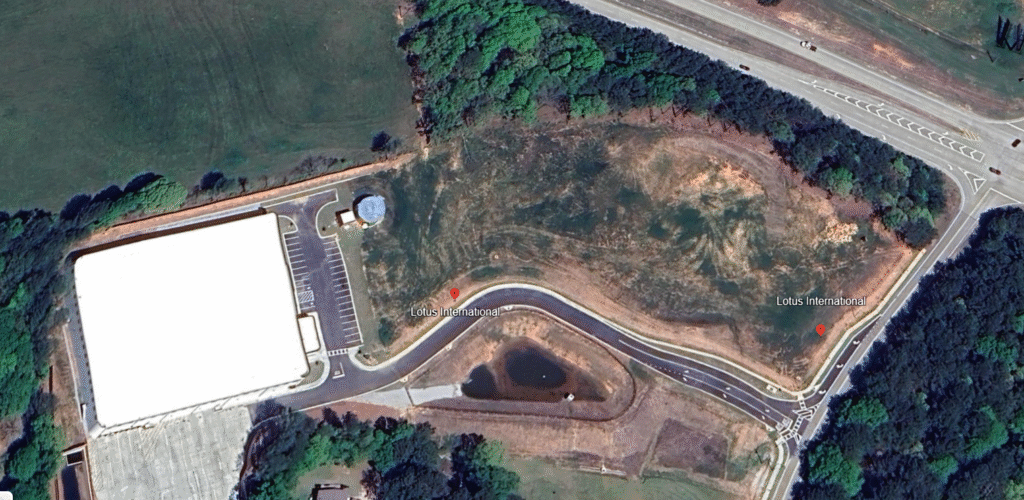
Lotus International’s project in Winder, Georgia is a great example of that strategy. The location offers strong practical advantages: it’s close to major highway access for regional distribution and trucking, and it sits within reach of a large workforce pool—a key factor for warehouse operations that depend on reliable staffing and flexible shift coverage.
But there’s a common tradeoff with “infrastructure-light” sites like this: the municipal utilities may not be sized for every aspect of a modern facility—especially fire protection.
On this project, the available municipal water infrastructure wasn’t sufficient to support the building’s fire sprinkler system demand. Rather than delaying the project or pursuing major public utility upgrades, the team implemented a proven solution: on-site fire-protection water storage and pumping, designed to meet applicable standards and satisfy code requirements.
Georgia Water Tanks delivered the critical piece: a 80,000 gallon NFPA 22-compliant fire water storage tank and controls, purpose-built for the site and integrated with the building’s fire protection system.
The site advantage: logistics + labor, without the urban constraints
Industrial and distribution facilities live or die by efficiency. A building can be perfect on paper, but if trucks can’t move easily, if staffing is a struggle, or if future growth is boxed in, operational costs rise quickly.
Winder checks a lot of boxes for businesses expanding in the Atlanta region:
Highway proximity supports inbound freight and outbound deliveries without pushing every truck through dense city traffic.
Workforce access matters for hiring, retention, and scaling operations over time.
Available land creates options for building layout, trailer storage, and future additions.
This is exactly why companies choose locations like Winder—because the site can support real operational growth.
But those advantages don’t always come with “big city utilities,” and fire protection is where that gap often shows up first.
The challenge: municipal supply that can’t meet sprinkler demand
Fire sprinkler systems are designed around worst-case scenarios, not everyday usage. They require specific flows and durations during a fire event. Even if a municipal system provides adequate pressure for domestic use, it may not have enough capacity to meet sprinkler demand—especially for larger buildings or facilities with specific hazard classifications.
When municipal supply falls short, the options can be painful:
fund or wait on utility upgrades (time-consuming, expensive, and not always feasible), or
create a private, code-compliant fire water supply on site.
For Lotus International, on-site storage was the clear, schedule-friendly path: it provides a dependable source of water for the sprinkler system without relying on uncertain municipal improvement timelines.
The solution: NFPA 22-compliant storage + pumping, integrated with the fire system
Georgia Water Tanks supplied and commissioned a fire-protection water storage tank and controls designed specifically for this facility. The tank met the requirements of NFPA 22 (Standard for Water Tanks for Private Fire Protection)—a widely recognized benchmark that guides how private fire water tanks are designed, built, and equipped.
To complete the system, Fire Sprinkler of Atlanta installed the fire pump, which provides the required pressure and performance for the sprinkler system during a fire event. Together, the tank + controls + fire pump create a robust, purpose-built fire protection water supply.
This setup does two important things:
Guarantees available water volume for the sprinkler system, independent of municipal limitations
Delivers the water at the required pressure, using the fire pump and appropriate controls
In plain terms: it makes the building feasible on a site where the municipal infrastructure alone would have limited or delayed development.
Fast execution: from concept to a standing tank in about four months
One of the most important parts of this project wasn’t just the final equipment—it was how quickly the solution moved from idea to reality.
This tank was not an off-the-shelf workaround. It was:
Designed and engineered to match the project’s fire protection requirements
Reviewed and approved by the project design team and the local code officials
Custom manufactured to meet the project’s specifications
Delivered and erected on site in about four months
That matters, because construction schedules don’t pause while the utility grid catches up. If a project needs fire protection to proceed—whether for permitting, insurance, or occupancy—then the fire water solution has to keep pace with the overall build.
This is where experienced coordination makes a difference: design alignment, code compliance, fabrication, and field erection all have to work as one chain. If any link slips, the schedule slips. On this project, the system was developed and executed on a timeline that supported the facility’s broader goals.
Why this matters: enabling economic development without waiting on infrastructure
Projects like Lotus International’s Winder facility highlight a reality that rural and semi-rural communities face all the time: land is available and the workforce is there, but utility infrastructure may not be sized for modern commercial requirements—especially fire protection.
When municipal water supply can’t meet sprinkler demand, the default assumption is often that the project will require costly, time-consuming public infrastructure upgrades (larger mains, storage, booster stations, etc.). Sometimes those upgrades are warranted—but they can also delay projects for months or years, and they aren’t always financially realistic for a single development.
An on-site, standards-based fire protection water supply changes that equation. By pairing an NFPA 22-compliant fire water storage tank with proper pumping and controls, a project can move forward safely and to code without placing a major new burden on public infrastructure.
That matters because it helps communities capture the benefits of development sooner:
Jobs and local hiring
Increased tax base
More viable use of rural industrial land
Growth without requiring immediate, large-scale utility expansions
In short: solutions like this help businesses invest in rural areas while keeping the overall project practical—for the owner, the design team, and the community.
The takeaway
Lotus International’s Winder, GA project highlights a practical truth about growth: great sites aren’t always fully served by big-city infrastructure, and successful projects plan accordingly. The location offers real operational strengths—highway access and a strong workforce pool—and the fire protection solution ensured the site could support a modern facility.
Georgia Water Tanks supplied the NFPA 22-compliant fire water storage tank and controls, and Fire Sprinkler of Atlanta installed the fire pump. The result is a reliable, standards-based fire protection water supply—designed, approved, custom manufactured, and erected in about four months—that helped the project move forward without requiring major municipal water infrastructure upgrades.
It’s a good example of how rural communities can support new employers and growth without waiting on expensive utility expansions.
Tech Square 3 (TS3) — George Tower | Scheller Tower — is one of Georgia Tech’s biggest recent additions to Midtown Atlanta: two connected towers (18 stories and 14 stories) delivering 400,000+ square feet of new academic, research, and collaboration space.
Alongside the architecture and program, TS3 carries a sustainability story that we love being part of: Georgia Tech chose to implement rainwater harvesting for both irrigation and toilet flushing—continuing a campus-wide commitment to practical water reuse.
Rainwater harvesting works best when it’s treated like infrastructure—not a one-off “green feature.” That’s exactly how Georgia Tech has approached it. TS3 is the fifth such system on campus, and Georgia Water Tanks has supplied four and maintains all five.
At TS3, Georgia Tech is also pursuing broader building performance goals, including a push toward LEED Platinum and portfolio-scale resource reduction.
A proven design—refined over 15 years
One of the things we’re proudest of on projects like TS3 is that the system isn’t experimental. It’s based on a general design approach we’ve used and refined for roughly 15 years—the kind of design that gets better because it’s been installed, operated, maintained, and improved in the real world.
That means the TS3 rainwater harvesting system reflects years of lessons learned about:
keeping collection and storage straightforward
building in maintainability from day one
using controls and monitoring that make performance visible
making the system easy to service without downtime surprises
Partnering with TigerFlow Systems
TS3 was also one of our earlier rainwater systems that we partnered on with TigerFlow Systems. TigerFlow brought two things that made a real difference:
new insight on the design, helping validate and improve the way the system comes together, and
quality manufacturing, which matters in the places most people never see—fit, finish, reliability, and long-term serviceability.
Good partners don’t just “build what’s on the plans.” They improve the end result. That collaboration helped sharpen elements of the approach we continue to use today.
Why long-term maintenance is part of the sustainability story
A rainwater harvesting system only delivers savings if it keeps working. That’s why we think it’s important that Georgia Tech has treated these systems as part of ongoing operations—something to be maintained, monitored, and supported over the life of the building.
TS3 also includes building-wide monitoring strategies for performance—reinforcing the idea that sustainability is measured, not assumed.
What TS3 represents for Atlanta projects
Atlanta gets plenty of rain. The real opportunity is building systems that are:
practical enough to repeat across a campus or portfolio
robust enough to keep working for decades
supported by partners who care about quality and long-term outcomes
Tech Square 3 is a strong example of that mindset in action.
At the heart of downtown Atlanta, the Northyards Building stands as a beacon of sustainable development. Originally redeveloped in 2002 with an eye toward environmental responsibility, this property has continued to innovate in its approach to water management. Today, we’re thrilled to share an exciting new chapter in its story: converting its stormwater detention system into a rainwater harvesting solution.
A Sustainable Foundation
The Northyards Building was a forward-thinking project from the start, incorporating stormwater detention to comply with early 2000s regulations. This system was designed to slowly release stormwater into the combined stormwater and sewer piping—a system notorious for overflows of raw sewage during heavy rain events.
While effective for its time, stormwater detention alone wasn’t enough to address Atlanta’s growing water challenges. Enter the next phase of sustainability: a rainwater harvesting system designed not only to reduce runoff but to turn stormwater into a valuable resource.
The Conversion Process
The property owner at Northyards sought a practical solution to reuse stormwater for landscaping irrigation. Here’s how we brought that vision to life:
Storage Capacity: A new 50,000-gallon above-ground tank was installed to store stormwater for reuse.
Pumping Upgrades: New pumps were added to the existing stormwater vault to transfer water into the storage tank. A second set of pumps in the cistern now powers the irrigation system.
Leak Detection: During the project, we discovered small leaks in the irrigation piping—an issue that had gone unnoticed. Repairing these leaks will ensure efficient water use moving forward.
Early Observations
One of the most exciting discoveries so far has been the cleanliness of the water. The vault, which collects runoff from an adjacent parking deck, was expected to contain significant sediment and debris. Instead, we’ve found that much of the sediment settles in the vault itself, leaving the water pumped into the cistern remarkably clear.
Looking Ahead
It will be next year before we can measure how much potable water this system has saved, but the potential is promising. Beyond water conservation, this project helps reduce strain on Atlanta’s combined sewer and stormwater system, mitigating overflow risks during storms.
This initiative also highlights the importance of revisiting existing infrastructure with fresh eyes. What was once a standard detention system is now a vital part of a greener future.
Inspiring Change in Urban Sustainability
The Northyards Building’s transformation is a testament to what’s possible when innovation meets commitment. By turning stormwater into an asset, we’re not only addressing current water challenges but also setting an example for others to follow.
Here’s a link to the owner’s article about their sustainability efforts.